
Japan has been exporting vehicles for decades, and the reasons why buyers across Sri Lanka, Southeast Asia, and beyond consistently turn to Japanese imports haven’t changed much. The build quality is reliable, the maintenance history tends to be meticulous, the variety covers everything from compact city cars to heavy machinery, and the pricing — particularly for certified used vehicles — sits in a range that makes sense for the quality delivered.
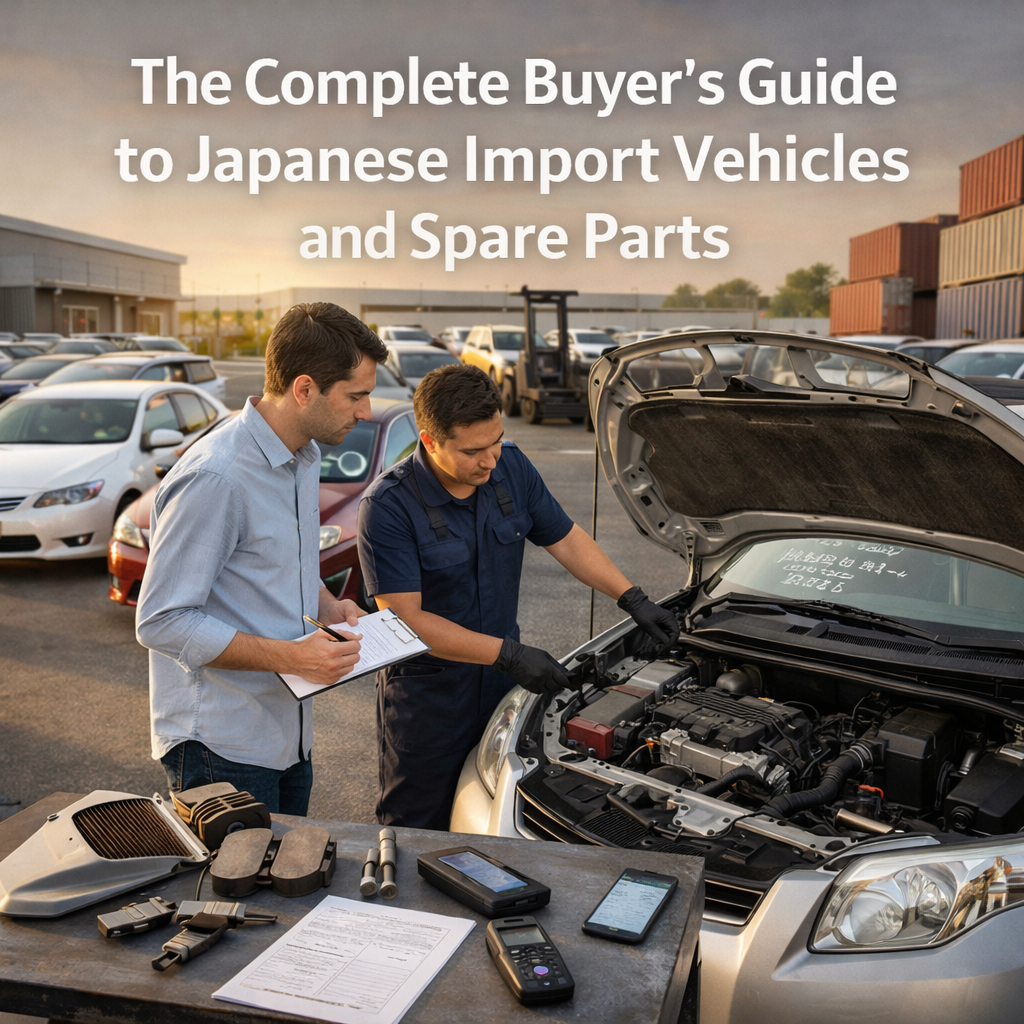
What has changed is how buyers approach the process. The days of relying entirely on word of mouth or showing up at a yard to see whatever happened to be available are mostly gone. Buyers today research specific makes and models before committing, compare multiple options, ask detailed questions about condition and documentation, and want to understand the import process before they sign anything. This is a healthier way to buy — but it requires knowing what to actually look for, what questions matter, and where the real differences between a good purchase and a disappointing one tend to show up.
This guide covers all of that: how to think about Japanese imports as a buyer, what separates reliable importers from unreliable ones, how to evaluate vehicles before committing, what spare parts sourcing actually involves, and the practical steps that lead from initial research to a purchase you feel confident about for years.
Why Japanese Imports Specifically
The quality argument for Japanese vehicles starts with how the domestic Japanese market works. Japan has strict vehicle inspection standards — the shaken system — that require cars to meet rigorous safety and emissions requirements every two years. Because these inspections become progressively more expensive as vehicles age, many Japanese owners choose to sell or export perfectly functional vehicles rather than continue paying inspection fees. The result is a supply of well-maintained, relatively low-mileage vehicles entering the export market at ages and prices that make them genuinely attractive to buyers outside Japan.
This is different from how used vehicles enter export markets from many other countries, where the reason for selling is often mechanical deterioration or accident damage rather than regulatory cost. Japanese domestic market (JDM) vehicles exported through reputable channels tend to have genuine service histories, documented mileage, and conditions that align with what the paperwork says — not always, but at a rate that has built the reputation Japanese imports carry.
The machinery and industrial equipment side follows similar logic. Japan’s industrial sector maintains equipment to high standards and cycles it out regularly as companies upgrade or restructure. Heavy machinery, construction equipment, and specialized industrial tools entering the export market from Japan are often in working condition with documented service records, which matters enormously when a piece of equipment is going to be used in a commercial context where downtime is expensive.
What to Evaluate Before You Commit to Any Vehicle
For used vehicles specifically, the evaluation process has several layers, and most buyers who end up disappointed skipped at least one of them.
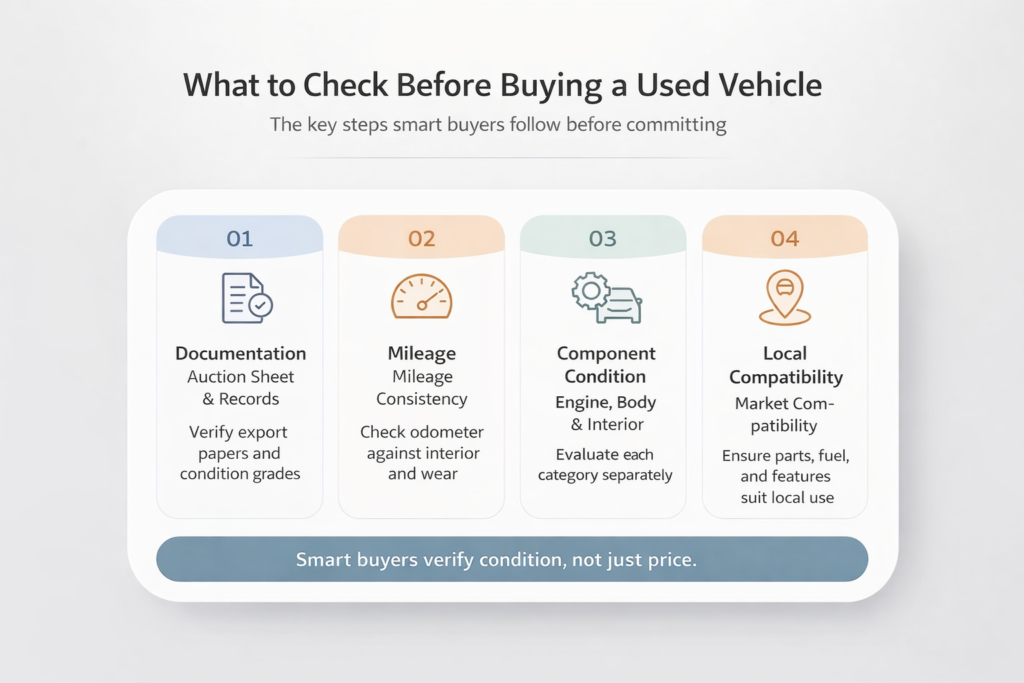
Documentation first. A Japanese export vehicle should come with an auction sheet if it passed through a Japanese auction house — most legitimate trade vehicles do. The auction sheet grades the vehicle on a scale, describes its condition in detail, and notes any known defects. Grades of 3.5 and above are generally considered reliable used stock. Anything below that deserves close scrutiny of the specific notes, not just the overall grade. An importer who can provide auction sheets and explain what they mean is a meaningful signal of transparency.
Mileage verification. Japan’s domestic odometers read in kilometers, which removes one layer of conversion confusion compared to some other import markets. However, mileage should be cross-referenced against the condition of the interior, tyres, and mechanical components. A vehicle claiming 60,000km with heavily worn seats, a cracked steering wheel, and smooth brake pedal rubber has a mileage story that doesn’t add up. These discrepancies aren’t always fraud — sometimes vehicles genuinely have unusual wear patterns — but they warrant direct questions.
Condition grading by category. Beyond overall grade, condition varies by component. Engine and transmission condition matters most for long-term reliability and long-term cost. Body condition matters for value retention. Interior condition matters for daily use satisfaction. Electrical system condition matters increasingly as vehicles get more electronic — and modern Japanese compact cars have more electronics than buyers sometimes expect. Know which of these categories matters most for your specific use case and weight the evaluation accordingly.
Compatibility for the local market. Japanese domestic market vehicles are built to Japanese specifications, which differ in some ways from vehicles destined for other markets. Headlight settings in Japan are for left-hand traffic, which aligns with Sri Lanka. However, tyre sizes, fuel specifications, and emissions configurations vary. A reputable importer will have managed these considerations already and can tell you precisely what the vehicle’s status is on each of these points without being pushed for answers.
Spare Parts: The Consideration Most Buyers Underestimate
One of the most common mistakes buyers make when purchasing an imported vehicle is focusing entirely on the purchase price and not thinking through parts availability until something needs replacing.
This matters differently for different vehicle categories. For mainstream Japanese makes — Toyota, Honda, Suzuki, Daihatsu — parts availability in Sri Lanka is generally strong because these vehicles have been imported in volume for long enough that the local aftermarket has developed around them. Standard service items like filters, belts, brake pads, and common wear components are widely available and reasonably priced.
Where it gets more complicated is with less common models, newer model years where the local market hasn’t fully caught up yet, or specific components like ECU units, ABS modules, and transmission components for models that weren’t officially sold in the local market. For these, buyers are often dependent on the same import channels that brought the vehicle in — sourcing the part directly from Japan, which adds lead time and complexity to any repair.
The smart approach is to ask the importer specifically about parts availability for any vehicle you’re seriously considering before you buy. A good importer knows which models have strong local parts support and which ones require ongoing reliance on international sourcing. They should be able to answer this question clearly because it’s directly relevant to the total cost of ownership calculation their customers are making.
For industrial machinery and equipment, parts planning is even more critical. A piece of machinery that sits idle because a specific component takes six weeks to source from Japan creates costs that can dwarf the original purchase price. Before committing to any machinery purchase, it’s worth establishing the parts sourcing pathway for the components most likely to need replacement during the machine’s working life.
How to Identify a Reliable Importer
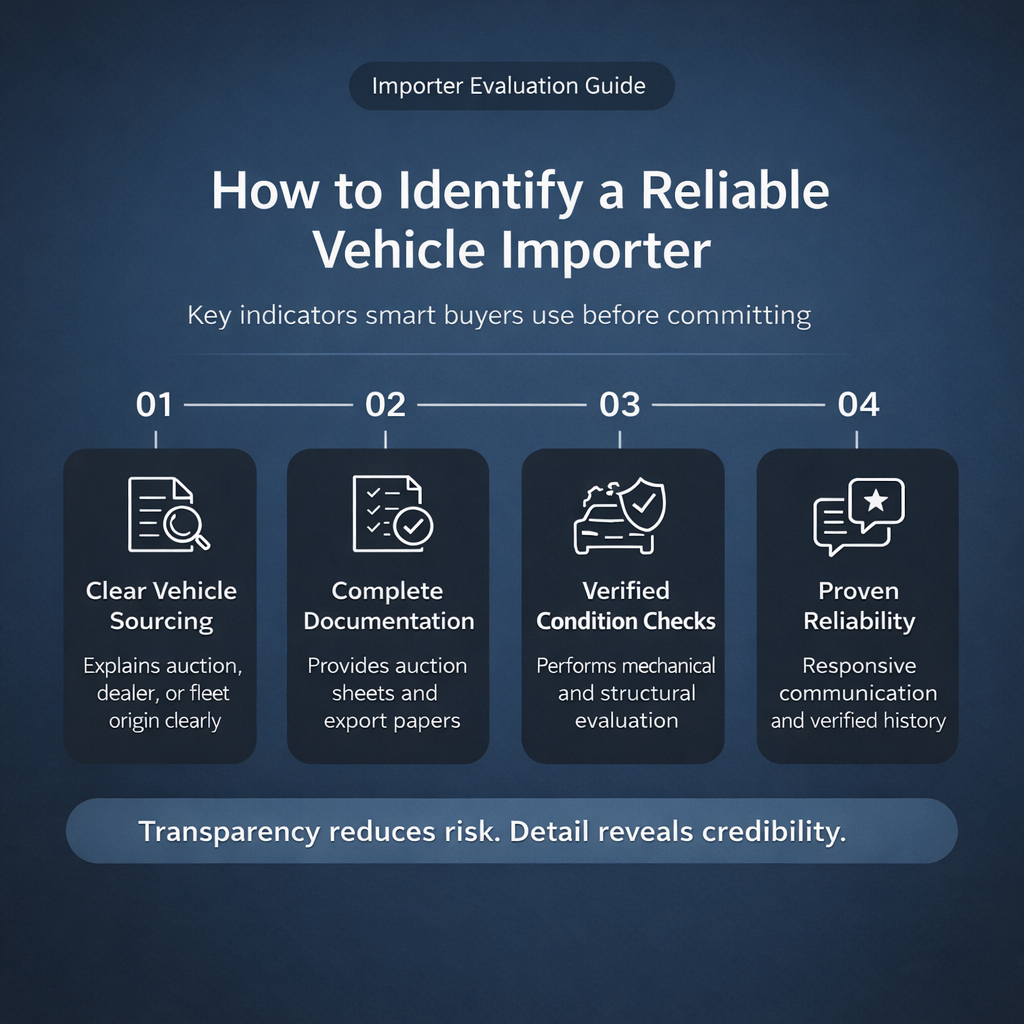
The import vehicle market, like any market with high-value transactions and information asymmetry between buyer and importer, has operators across a wide quality spectrum. Identifying the reliable ones requires more than just looking at inventory.
Transparency about the sourcing process is one of the clearest indicators. Importers who can explain specifically how vehicles are acquired — auction, direct dealer, fleet clearance — what documentation comes with each vehicle, and what condition checks are performed before the vehicle is offered for sale are providing information that unreliable operators either don’t have or don’t want to share. The details matter. “We source from Japan” says almost nothing. “We source through licensed Japanese auction houses and can provide the original auction sheet for every vehicle” says quite a lot.
Physical inventory visibility is another signal. Being able to see actual vehicles, with their actual specifications, presented honestly — including noting things that aren’t perfect rather than only emphasizing positives — reflects a business operating with some confidence in its product quality. A lot of photography taken to disguise rather than reveal condition, or descriptions that never acknowledge any flaws, should prompt closer inspection.
After-sale support matters even for as-is purchases. An importer who helps with documentation, customs clearance, and registration processes — and who can connect buyers with parts sourcing when needed — is providing ongoing value that justifies the relationship beyond the initial transaction.
The Research Phase and Staying Organized
Researching imported vehicles involves filling out inquiry forms across multiple platforms, registering to receive notifications from several importers, requesting price lists, and asking for auction sheets or condition reports for specific vehicles. Within a week of active searching, the email account used for this research typically contains dozens of messages — responses from importers, follow-up marketing sequences, price alerts, and promotional newsletters that bear no relation to the original inquiry.
The practical consequence is that genuinely useful communications — specific responses to specific vehicle inquiries, documentation attachments, price updates on vehicles being actively considered — get buried in a feed that’s now dominated by marketing content. Missing a follow-up on a specific vehicle because the inbox is unmanageable is a real risk when the vehicle market moves quickly.
A habit many active vehicle researchers have adopted is using a separate address during the exploration phase when initially registering on multiple platforms or submitting general inquiries to importers they haven’t yet decided to engage with seriously. The inquiry responses still arrive, the documentation still comes through, and the primary email address stays reserved for the importers and specific vehicle inquiries that have moved into serious consideration. When a vehicle purchase moves from research to active negotiation, contact information gets updated accordingly, and the real communication channel stays clean.
What the Actual Purchase Process Involves
Understanding what happens between selecting a vehicle and taking delivery helps set realistic expectations and reduces the friction that comes from surprises.
Deposit and reservation. For vehicles being shipped from Japan, most legitimate importers require a deposit to hold a specific vehicle during the shipping window. This is standard practice and protects both sides — the importer against buyers who express interest and disappear, and the buyer against the vehicle being sold to someone else while in transit.
Shipping and transit time. Japan to Sri Lanka shipping typically takes three to five weeks depending on the specific shipping route and vessel schedule. During this period, the vehicle is in transit and unavailable for inspection. Good importers provide tracking information and communicate proactively if there are any delays.
Customs clearance and documentation. Import duty, port handling charges, and customs clearance costs are separate from the vehicle purchase price and need to be factored into total cost calculations. An importer who is transparent about these costs upfront — providing a landed cost estimate rather than just a FOB Japan price — is doing buyers a genuine service. The difference between FOB price and fully landed, registered vehicle can be significant.
Registration. Imported vehicles require registration with the local transport authority, and the documentation requirements vary depending on whether the vehicle is new or used and what its previous registration status was. Experienced importers have managed this process repeatedly and can guide buyers through it or handle it directly.
Making a Decision You’ll Be Satisfied With Long Term
The imported vehicle market rewards buyers who do the research. Not extensive, weeks-long research on every available option — but focused research on the specific question of whether a particular vehicle, from a particular source, at a particular price represents a sensible purchase given how it will actually be used.
The vehicles and machinery available through direct Japanese import channels are genuinely good products when sourced properly. The challenge is distinguishing proper sourcing from improper sourcing, and understanding the total cost picture rather than just the sticker price. Buyers who work through those two questions carefully end up with vehicles and equipment that serve them reliably for years.